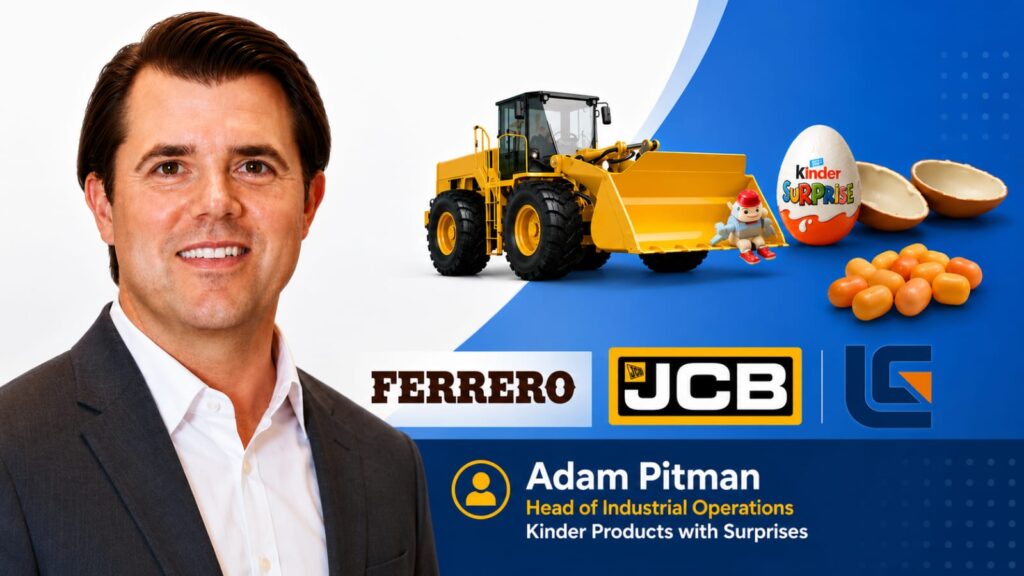
So, how does an Engineer turned Global Operations Executive go from producing wheel loaders and excavators for some of the finest construction equipment manufacturers to the toy industry? I’ll explain more in this exclusive interview…
Introduction: Construction Equipment to Toys?!
It takes real courage and confidence in your abilities to make such a career pivot, but Adam Pitman modeled that it can be done, and in this interview, Adam outlines how he made the leap from heavy machinery to one of the most recognizable toy manufacturers globally. The insight is valuable for anyone who has spent the majority of their career working in one industry, and has perhaps wondered what else is out there for them.
It was a calculated gamble that paid off for Adam and he’s now leading an ambitious, yet achievable goal of producing 1-billion toys a year. A significant change considering the average turnaround time for a new wheel loader machine, from initial design concept to prototype usually takes six (6) to twelve (12) months, with the overall process often extending to one (1) to two (2) years.
This was not as simple as submitting his resume. Adam had to mentally shift his mind, leveraging all of his transferable skills, defining & articulating his accomplishments, and demonstrating the fortitude and aptitude to pacify any concerns across the table.
Many haven’t done this because they don’t believe they can, or they don’t have examples of others who have done it successfully. Adam is proof that taking the leap into an entirely new sector is not only achievable but can be very rewarding.
Intrigued by Adam’s pilgrimage from a domain that he dominated to an industry that he had no prior knowledge of or expertise in, I believe his journey will resonate with engineers from all walks of life and motivate them to think outside of their box.
The Interview
1. Did you proactively pursue a change of industry, or did it just fall into your lap?
A bit of both, honestly. I had spent close to 20 years in the construction equipment and off-highway industry, and I was very comfortable there. I understood the products, the customers, the engineering side, and the manufacturing environment extremely well.
But deep down, I also felt that if I stayed in the same industry forever, I might limit my own growth. I wanted to test myself somewhere completely different and see whether my skills and leadership style could transfer into a new environment.
When the opportunity with Ferrero and KPS came along, it felt exciting, but also slightly uncomfortable — which was probably a good sign. Looking back now, it was one of the best decisions I made because it pushed me far beyond just engineering and operations and helped develop me into a much broader business leader.
2. How did you mentally and practically prepare for the change to a completely new industry?
The biggest thing mentally was accepting that I would not walk in as the expert anymore. In my previous industry, I had years of experience and confidence behind me. Suddenly, I was entering a world where I had to learn new terminology, new processes, new expectations, and even a completely different business culture.
I tried to approach it with curiosity instead of ego. I listened a lot, asked questions, spent time with suppliers and teams, and tried to understand why things were done a certain way before trying to change anything.
Practically, I immersed myself in learning the full product lifecycle and understanding how fast-moving consumer products operate compared to heavy industry. What surprised me most was how connected everything was — engineering, marketing, licensing, quality, supply chain, operations — everyone influences the final product and customer experience.
3. What were the main challenges you encountered during the transition?
The speed was probably the biggest shock initially. In construction equipment, projects can move over very long timelines. In the toy industry, everything moves incredibly fast, and the level of coordination required is huge.
Another challenge was realizing that technical excellence alone is not enough. In the toy industry, you are balancing creativity, branding, cost, safety, automation, visual quality, consumer expectations, and very tight timelines all at once.
Personally, there was also a challenge in rebuilding confidence in a completely new environment. When you move industries, there are moments where you question yourself because you are no longer the person with all the answers. But over time, that discomfort becomes part of the growth.
4. What was the steepest learning curve for you?
Honestly, it was understanding how much complexity sits behind such a small product.
From the outside, people see a small Kinder toy and think it is simple. But behind that product there are development teams, mold makers, automation, quality systems, safety regulations, supply chains, marketing approvals, licensing agreements, manufacturing partners across multiple countries, and huge production volumes.
I remember realizing quite early on that although the product was physically smaller than what I worked on before, the business complexity was in many ways even greater. That was a real eye-opener for me.
5. How was your background in construction equipment design beneficial or transferable to the toy industry?
At first glance, the industries look completely unrelated, but actually many of the core skills transferred really well.
My engineering background taught me structured problem-solving, manufacturing discipline, supplier management, quality thinking, and how to lead teams under pressure. Those fundamentals apply almost anywhere.
I also think coming from a completely different industry gave me a fresh perspective. Sometimes when you grow up entirely inside one sector, you naturally inherit the same ways of thinking. Coming from outside allowed me to challenge certain assumptions and bring a different operational mindset.
Most importantly, my previous experience gave me resilience. In manufacturing and operations, problems happen every day. Learning how to stay calm, practical, and solutions-focused during pressure situations was something that transferred very strongly.
6. What advice would you offer to someone who is facing a similar decision or thinking about a change?
I would say don’t let fear of being uncomfortable stop you. Most major growth in your career happens when you step into situations where you don’t fully know what you are doing yet.
Also, don’t underestimate how transferable your experience is. You may not know the product or industry initially, but leadership, communication, problem-solving, resilience, and work ethic matter in every business.
At the same time, stay humble. Be willing to learn again. Ask questions. Listen carefully. The people who adapt fastest are usually the people who are confident enough to admit what they don’t know.
Looking back, changing industries probably accelerated both my personal and leadership growth far more than staying in my comfort zone would have. It forced me to become more adaptable, more commercially aware, and much broader in the way I think as a leader.
—
Adam has made himself available to anyone who is at a career intersection who is perhaps feeling stagnant in a lane they’ve spent more than a decade working in.
You are one mental adjustment away from injecting life back into your career and doing something out of your comfort zone.
Designing the same thing every day makes you a specialist. Diversifying your career makes you a specialized generalist.
—
About Troy/Talent Search Partners
Greetings! I’m Troy, Managing Partner and Search Partner for Talent Search Partners with over 15 years in the industry. I take a consultative approach to how I source talent for my client’s and enjoy the one-on-one engagements with candidates.
Since 2019, Talent Search Partners has been providing professional services to job-seekers and employers. We’ve learned that staffing is not a numbers game — it’s a relationship-building business based entirely on trust and honesty. That’s why we put an emphasis on listening, guiding, and matching.